
Monroe Parole and Probation
Physical release and legal discharge are separate events. A person may leave an Ohio prison and enter parole or post-release control administered by ODRC's Adult Parole Authority. A person may leave the Monroe County Correctional Facility under probation or community control imposed by County Court or Common Pleas. These paths use different records and different decision makers.
| Supervision | How it begins | Who tracks it | Best public proof |
|---|---|---|---|
| Parole | The Parole Board approves release on a parole-eligible sentence. | ODRC Adult Parole Authority | ODRC status and parole/release detail |
| Post-release control | State supervision follows a stated prison term under sentencing law. | ODRC Adult Parole Authority | ODRC detail and sentencing entry |
| Probation/community control | A Monroe County court orders community supervision instead of or after confinement. | The sentencing court and its probation function | County Court or Common Pleas docket |
| Judicial release | The sentencing court interrupts an ODRC term and normally imposes community-control terms. | Sentencing court, with ODRC history still relevant | Common Pleas entry plus ODRC status |
- Parole
- Discretionary community release for a parole-eligible sentence, subject to state supervision.
- Probation
- Court-ordered community supervision, often called community control in Ohio records.
- Post-release control
- A period of APA supervision after a stated prison term.
- Final discharge
- The point when the applicable correctional or court supervision ends.
Verify Monroe Post-Release Supervision
Start with the sentence source. A state prison episode points to ODRC. A county sentence or local community-control order points to the court. A person can have records in both systems, so the newest relevant entry and exact case number matter.
- Open the ODRC Offender Search and search by name or the prefixed offender number.
- Run the APA Supervision filter. Also inspect Released and Violators at Large so a status is not mistaken for final discharge.
- Open the detail record and read current status, supervision period, residential county, and the “APA Offices” field when displayed.
- For county probation, search County Court CaseLook for misdemeanor matters and the Clerk/Common Pleas public route for felony community control.
- Read sentencing, violation, modification, revocation, and termination entries in date order.
- If the record remains unclear, ask the named supervising office, ODRC Central Records, or the correct clerk to verify the official entry.
A lack of ODRC results does not prove Monroe County probation ended. ODRC is not a universal database of local court supervision.
The Monroe County released-inmate search and records path shows how the underlying jail exit and court disposition fit beside a supervision result.
Monroe Supervision Office Record
Do not assign an APA field office from geography. No stable official county-to-office directory was verified. Use the individual ODRC detail record's “APA Offices” field because that is tied to the person's supervision. A residential county or ZIP can help establish context, but ODRC warns that an address may not be current, especially for a person listed at large.
ODRC Central Records / Offender InformationAttn: Central Records
PO Box 430
Columbus, OH 43216
614-752-1161
Include the offender number when requesting state records. For local probation, contact the clerk for the sentencing division. County Court is at 101 N. Main Street, Room 12, Woodsfield, and handles misdemeanor matters within its authority. Felony community-control entries are maintained through Common Pleas and the Clerk at the same street address.
Note: The supervising office shown on a live ODRC record is more reliable than a guessed office based on the last listed address.
Monroe APA Violators at Large
ODRC publishes an alphabetic Violators at Large list. It may show a name, offender number, date of birth, declared-at-large date, offenses, and a linked photo or detail page. The status proves an APA supervision context after prison release. It does not prove the person's present location, lawful final discharge, or a new Monroe County release.
ODRC says any shown address is the last recorded address before at-large status, not a known current location. The agency also instructs the public not to approach a listed person. Law enforcement must confirm warrants through LEADS or NCIC because the public list is not the warrant-verification system.
ODRC APA Fugitive Section614-752-1114
Fugitive.Val@odrc.state.oh.us
Use 911 for an emergency.
The published offender-search view demonstrates the difference between an APA status and a county jail record. Review the official list and its warning before treating any result as current.
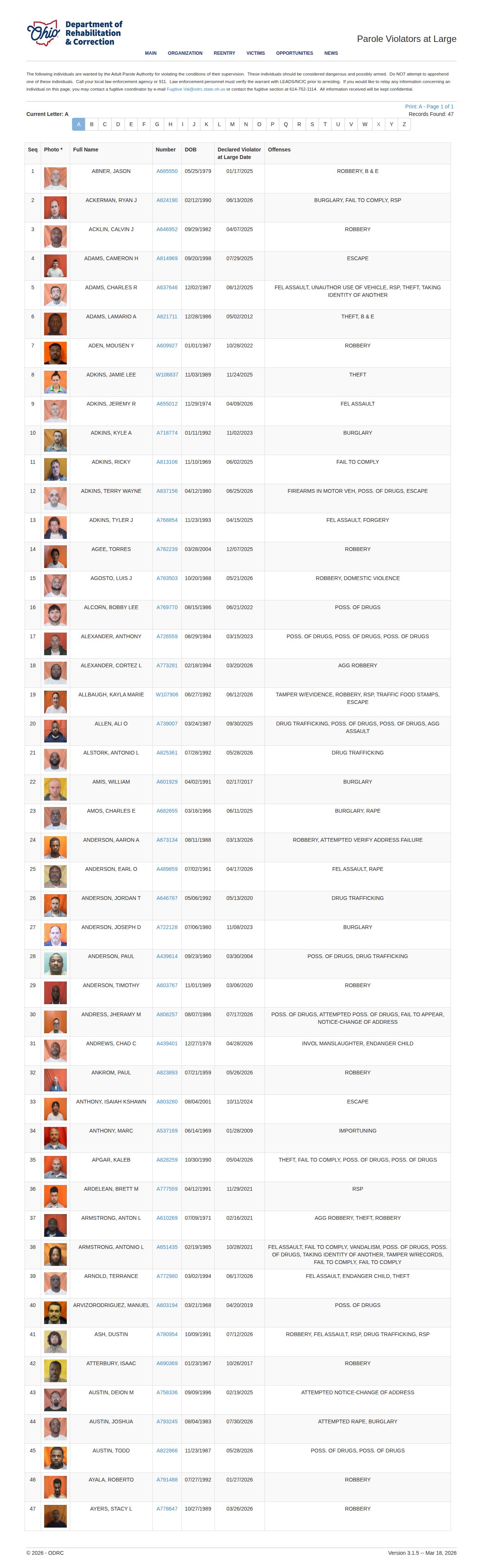
The screenshot shows the state lookup structure, while warrant confirmation and present location remain outside the public page.
Monroe Supervision Violations
Conditions depend on the sentence, release decision, and supervision plan. A violation allegation can lead to a warning, modification, hearing, sanction, revocation, or return to custody under the governing process. A docket entry or ODRC status should be read for what actually occurred, not what could occur in a general case.
Probation violations appear in the local court trail. Look for a filed violation, service or warrant entry, hearing, finding, modification, revocation, and any later termination. APA violations belong in ODRC and parole records. “Violator at Large” means the state alleges the person has absconded or is otherwise wanted by APA. It does not convert the old prison release date into a new county release event.
Ohio VINE can send custody-change notices when a participating agency supplies an event. It is an alert layer, not the supervision custodian and not a warrant check. Silence or a missing result never guarantees continued custody.
Monroe Parole Hearing Records
The Ohio Parole Board is part of the Adult Parole Authority. ODRC's public scheduling mechanism is a Next Parole Board Hearing Date search by month in YYYYMM format. It is a monthly search field, not a day-by-day calendar. An individual detail record can show the latest hearing or review type, result, and next review month.
Ohio Administrative Code 5120:1-1-11 requires decisions to be recorded in official minutes and provides for decision communication. Ohio Revised Code 5149.10 treats Board minutes, actions, findings, recommendations, determinations, and orders as public records. Request a missing minute with the offender number and hearing month.
Possible outcomes include approval, denial with a continued hearing, full-board review, reconsideration, deferral, continuance, or rescission. Eligibility comes from the actual sentence and current law, including ORC 2967.13 where applicable. A hearing month or favorable outcome is not the completed release event.
When Monroe Parole Becomes Release
A favorable Ohio Parole Board decision does not mean the person has physically left the institution. The official Parole Board handbook explains that review may continue until release. Pending charges, later institutional misconduct, a missing approved placement, or unmet conditions can delay or stop the planned exit.
Confirm the completed event afterward in ODRC's current Status and Parole or Release Detail. If APA Supervision appears, prison confinement ended but state authority continues. If another agency took custody, the receiving record must be checked. The release decision, the actual exit, and final discharge are three separate milestones.
Is a parole approval a release date? No. It is a decision in the release process. Current ODRC detail is needed to confirm whether and when the physical release occurred.
Monroe Supervision Final Discharge
Supervision ends through an official discharge or termination, not merely with the jail or prison exit. For APA cases, seek the ODRC status and release or supervision detail. For Monroe County probation, read the sentencing court docket for a termination entry. A violation, revocation, new case, or sentence modification can change the expected end.
Final discharge also matters beyond the supervision record. Ohio sealing waiting periods commonly run from final discharge, so the relevant date may follow physical release by months or years. Do not calculate that date from the jail exit alone. Use the current statute and the order or agency record that closes the remaining sentence components.
Note: A person can be released from confinement while still subject to lawful supervision; only the controlling record establishes final discharge.