
Monroe Release Forecasts and Actual Dates
A projected date is a forecast based on the sentence information and credits known when the record is calculated. An actual release date records a completed event. Those dates may match, but they do not have the same force. In the ODRC record, the field may read “Expected Release Date/Parole Eligibility Date.” For a definite eligible term, it can point toward expected sentence expiration. For a parole-eligible term, it may mark when Board consideration can begin rather than the day the person will leave.
A pretrial detainee at Monroe County Correctional Facility has no fixed sentence-expiration date. Bond, recognizance, dismissal, a court order, or transfer may change custody. Even after a judge signs an order, jail staff must receive, verify, and execute it. The court docket proves the legal event, while the jail’s release entry proves the physical exit transaction.
Find Monroe County Projected Release Dates
Begin by deciding whether the person is held by Monroe County, ODRC, or another system. A county booking with no state commitment should not be searched as though it were a state-prison term. Likewise, a transport from the county jail to ODRC ends local custody but does not start community release.
Use this custody-based sequence:
- Match the person by full name and, when known, booking or offender number.
- Check the Monroe County court docket for bond, sentence, jail credit, commitment, or judicial-release orders.
- For a state prisoner, search ODRC by name or the full prefixed offender number.
- Open the detail record and copy the exact expected-release, parole-eligibility, status, and release-detail labels.
- For a local jail term, request the sheriff’s existing sentence and release entry rather than applying ODRC credit rules.
- Check again after the forecast date to confirm the actual release, transfer, or continued custody.
The ODRC Offender Search accepts a last name alone or first and last name together. It also permits an offender-number search and filters such as Incarcerated, Released, APA Supervision, and Violators at Large. Search all relevant statuses. A person may have physically left prison but remain under APA supervision.
For a full identity and custody-source search before calculating dates, use the Monroe County release record lookup.
ODRC Monroe Release Date Labels
The ODRC definitions distinguish several terms. PRD means Projected Release Date. POA means parole on or after, the earliest date on which release to APA supervision may occur. A Next Parole Board Hearing Date is separate. If that date is in the future, ODRC says the review often takes place about two months before it. A date in the past may be the latest hearing date rather than evidence that release occurred.
The official ODRC search definitions show why the label on the individual record matters.
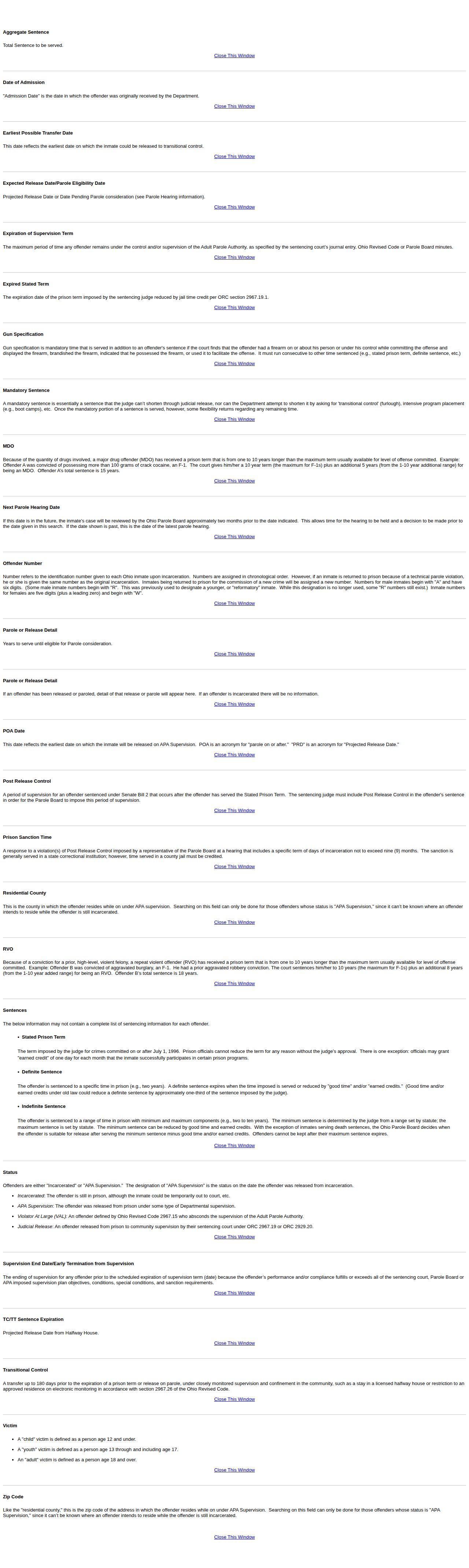
The definitions also explain that Parole or Release Detail appears after release or parole. An incarcerated person has no entry there. That completed-event field is stronger evidence than an empty institution line or an old projected-date screenshot.
ODRC number searches require the prefix. Male numbers generally begin with A, while some older records use R; female numbers begin with W. A technical parole violation may keep the same number, while a new crime can lead to another number. Review all matching episodes before tying one expected date to the Monroe County case.
Note: Record the retrieval date and exact ODRC label because sentence data and expected dates can change after the first lookup.
Ohio Credit Rules for Monroe Releases
Ohio’s current earned-credit framework is a distinctive part of this calculation. Ohio Revised Code 2967.194 governs credit beginning April 4, 2024, while the earlier ORC 2967.193 remains relevant to older accrual. Under the newer law, eligible state prisoners may provisionally earn one or five days for each completed month of productive participation in specified programs or activities. Administrative review applies, and credit can be denied or withdrawn for rule violations.
Ordinary participation or completion credit is capped at 15 percent of the stated term for an eligible sentence. Some diploma or program completions may allow a separate award under the statute. Many exclusions apply. Mandatory and otherwise nonreducible terms, along with specified murder, life-without-parole, sex-offense, violent, and other sentences, may receive no credit or only limited credit.
This does not create a universal rule that every Ohio prisoner serves 85 percent. That phrase comes from subtracting a 15-percent cap in one eligible category. Jail-time credit, consecutive or concurrent terms, mandatory time, parole eligibility, completion awards, judicial release, and Board action can all produce a different result. The individual sentence and current ODRC calculation control.
Qualifying Reagan Tokes indefinite terms add another distinction. Credit applies to minimum and maximum terms as the statute directs, while ODRC may rebut release at the minimum under the governing process. A displayed minimum date is therefore not an unconditional exit date.
The current rule and the dual-purpose expected-release label should be read together. A parole-eligibility marker is not sentence expiration, even when both appear beneath one field heading.
Monroe Jail Credit and Court Records
Jail-time credit accounts for qualifying confinement before commitment to ODRC. ORC 2967.191 governs that credit against a state term. The Monroe County sentencing entry and commitment record are vital because they state what the court awarded. If a credit figure is corrected, the expected release calculation can move.
County-jail good time is a separate issue. The Monroe County Sheriff’s public jail page does not publish a county good-time policy, sentence formula, weekend rule, or practice that shifts a Sunday release to Friday. Do not import ODRC’s state-prison framework into a local misdemeanor jail term. Ask the court for the journal entry and jail-credit record, then ask the sheriff for the executed release record.
The Monroe County Court record search covers matters within that court’s jurisdiction, while felony cases route through Common Pleas and the Clerk of Courts. Read the docket in order. A bond order concerns pretrial release. A sentence sets the term. A later appellate, judicial-release, or corrected-credit entry can change what looked final on an earlier date.
What Changes Monroe Release Dates
A projected release date changes when one of the facts used in the calculation changes. Some changes move the forecast earlier. Others move it later or replace it with a different type of date. The reason should be found in a court entry, ODRC sentence detail, Board record, or receiving-agency hold rather than guessed from the calendar.
| Factor | Possible effect | Record to check |
|---|---|---|
| Jail-time credit | A corrected confinement credit can alter the state calculation. | Sentencing entry and ODRC sentence detail |
| Earned credit | Approved credit can reduce an eligible term; denial or withdrawal can move the date later. | ODRC calculation under the applicable statute |
| Consecutive cases | Another term can extend the total period. | Court judgment entries and sentence detail |
| Court or appellate order | A correction, reversal, or judicial release can change the planned path. | Monroe County or appellate docket |
| Parole Board action | Approval, denial, or continuation affects parole-eligible timing. | Hearing result, minutes, and ODRC detail |
| Detainer or pending charge | Another agency may assume custody instead of a community release. | Release destination and receiving-agency record |
A detainer is a notice that another authority may want custody. It is not, by itself, proof that the handoff occurred. Request the Monroe County or ODRC release destination and then check the receiving system. Placement issues or a new institutional infraction may also delay a planned parole release.
Monroe Parole Dates and Decisions
Parole eligibility applies to the sentence, not to Monroe County as a local formula. ORC 2967.13 controls eligibility for covered parole-eligible indefinite and life terms, with exclusions and conditions that depend on the sentence. Many newer stated prison terms end through expiration and may be followed by post-release control rather than discretionary parole. Read the sentencing entry before treating an ODRC date as a Board release date.
The public schedule route is built into ODRC Offender Search. A user may enter a Next Parole Board Hearing Date month in YYYYMM form and open the matching detail record. The record can show the latest hearing or review type and result plus the next review month. This is a monthly search mechanism, not a promise that a person will leave on a listed day.
Ohio Administrative Code 5120:1-1-10 governs initial and continued hearing dates and projected dates for covered sentences. A separate hearing rule requires decisions to be recorded in official minutes and explains decision communication. Board outcomes can include approval, denial with another hearing, referral, reconsideration, deferral, or rescission. The exact result matters more than the mere presence of a hearing month.
Even a favorable Board decision is not the actual release. Review can continue, and pending charges, later conduct, placement issues, or conditions can delay or stop the planned event. After the forecast, check ODRC Status and Parole or Release Detail. If a minute is needed and is not posted, request it by offender number and hearing month.
Note: A hearing date marks review activity, while a completed ODRC release appears later in current status and parole or release detail.
Confirm Monroe County Actual Release
Confirmation comes after the event. For a state term, read current ODRC Status together with Parole or Release Detail. “APA Supervision” means prison confinement ended but state authority continues through parole, post-release control, or another APA status. “Released” describes the ODRC episode and does not promise that no other agency has custody.
For a county term, call Monroe County booking at 740-472-1612, option 4, and ask whether the person remains physically housed. When a written record is needed, request the booking/release log entry, actual release date and time, release type, authority, and destination or receiving agency. The court order explains the legal basis; the jail record shows when staff completed the exit.
A pending event can also be monitored through a Monroe County VINE inmate check. Treat the alert as notice and verify it with the record custodian. Federal BOP and ICE dates use separate federal tools, so an Ohio expected date should never be carried into a federal or immigration episode.